Starving With Cancer? How Zinc Impacts Appetite Signals and Taste
Category: Appetite Loss Solutions
If you’re watching someone with cancer lose weight, and everyone keeps saying, “just eat more,” stop. Eating more usually isn’t the answer. I know this because I lived it. I didn’t just lose interest in food, I lost the ability to eat.
It started with less food noise than normal, and then everything tasted metallic, bitter, or just off. Smells began triggering nausea, meat became unbearable, sweet flavors disappeared, and food didn’t feel neutral or comforting anymore, in fact it slowly turned into my enemy.

Well-meaning people kept urging me to “just try eating this, that, and the other thing,” not realizing that every bite already felt like a battle I was losing. I remember one day, looking at a favorite meal I used to love, and feeling completely defeated because I couldn’t even bring myself to take a bite. That sense of helplessness sticks with you forever.

Taste and appetite aren’t just preferences, they’re signals our brain receives from our taste buds and smell receptors. One of the things that plays a key role in how these signals function is zinc, and low zinc can be a contributor as to why taste signals start to fail.
Often, the first thing you notice is that food just doesn’t taste right. It’s metallic, bitter, or just off, and smell changes usually accompany the taste changes, making some familiar aromas suddenly unpleasant or nauseating. Appetite loss usually follows next, because when taste and smell signals are disrupted, the brain isn’t getting the usual cues that it’s time to eat.
That sequence — taste first, smell next, then appetite loss — can make weight loss go from gradual to sudden and confusing very quickly, even when you’ve been eating “enough” in the past.
Cancer accelerates this problem in several ways. Food intake drops because it’s become unbearable, absorption can be impaired, and inflammation increases demand. Treatments like chemotherapy and radiation add stress, and stress itself can affect zinc, appetite, and taste signaling, making the cycle worse. All of these factors together can change taste, appetite, and digestion more quickly than anyone expects.

Labs don’t always tell the full story either. Illness can shift how zinc shows up in bloodwork, so results might not reflect what’s happening at the tissue level. That’s why even “normal” labs don’t always mean the appetite signal is functioning properly.
This sets up a vicious cycle. Food tastes bad, intake drops, nutritional status worsens, appetite signals weaken further, and muscle loss accelerates. From the outside, it can look like someone isn’t trying – they’ve thrown in the towel – when in reality, their body is overwhelmed and the signals are broken.

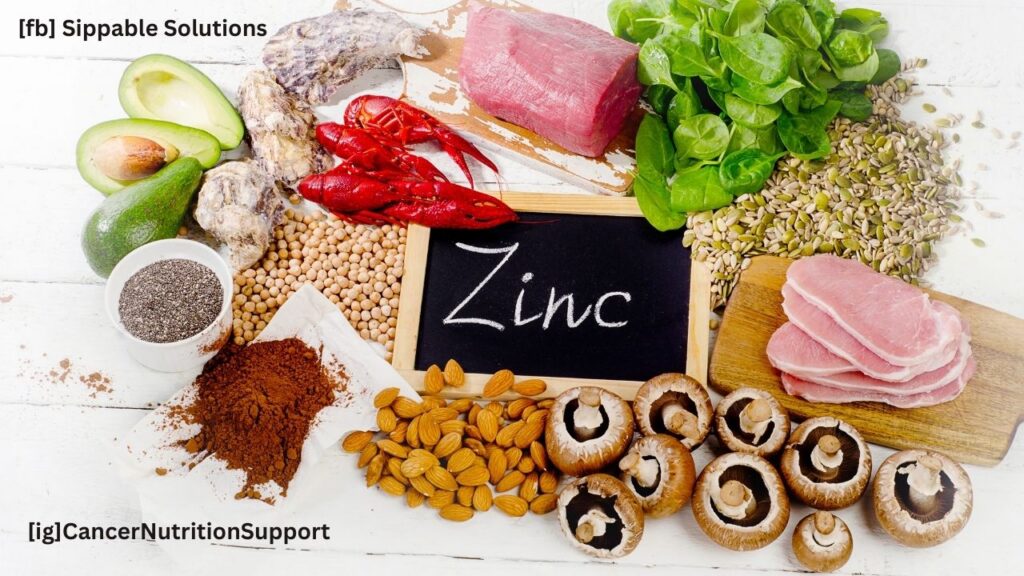
For people in treatment who can still tolerate some foods, there are several food-based ways to increase and support zinc intake. Googling “foods high in zinc” will give you examples like pumpkin seeds, oats, lentils, mushrooms, or miso broth. Pairing them with vitamin-C-rich foods like citrus or parsley can improve absorption. Keep in mind, this is a preventative step. Once appetite has collapsed, these strategies aren’t going to be a fit.
By the time I was losing weight rapidly, eating was not possible anymore. Food-based strategies were off the table, no matter how nutritious or well-intentioned they were. That’s why supporting the signal itself as early as possible matters. Managing stress (as much as possible) can also help preserve zinc and support taste and appetite signals, even if it won’t fix everything – at least it helps.
Short-term zinc supplementation can sometimes help taste and appetite signals recover enough for food to become tolerable again, but the form and dose matter. Zinc picolinate or bisglycinate are usually tolerated better than zinc oxide or gluconate. Most of the nutrition literature out there suggests around 30–50 mg/day, typically taken with food to reduce stomach upset. If you can’t eat, I get it. I’ll get to that.

This is informational, not a recommendation that should be followed without the advice of their health providers first – always check with your doctors and it wouldn’t be a bad idea to check with your pharmacist either. Zinc shouldn’t be used for long-term use without guidance. Taken incorrectly, it can actually worsen nausea or interfere with other minerals or medications. Again, always discuss supplementation with your healthcare provider.
For caregivers, noticing the early signs I’ve mentioned – taste changes, smell distortion, reluctance to eat, sudden nausea with familiar foods – can help give you an understanding of what’s happening before it feels like it’s too late and for patients, it’s important to remember: this isn’t your fault. Your body is overwhelmed; the signal is impaired, and it’s okay. The good news is that you have options that are put together in a guide for you.

What I share isn’t medical advice, it’s lived experience of what worked for me and many others. My guide will show you how I got the nutrients my body needed when eating was impossible, how I minimized pill overload, and supported my body when food alone wasn’t an option anymore. Sometimes the body needs support for the signals to fire off first. Recognizing the early signs can change how we help, but if you’re past that and want my step-by-step guide for supporting your body when eating is impossible, comment FUEL and I’ll send it to you.
Have a story you’d like to share? Drop it in the comments so others don’t feel so alone, I’d love it! Until next week….
Dannie Cade


Facebook Comments